 "At the beginning
Eurynome,
Goddess of All Things, emerged naked from Chaos and did not find anything solid where to put
her feet: she then divided the sea from the sky and danced alone on the waves.(Note 1)
"At the beginning
Eurynome,
Goddess of All Things, emerged naked from Chaos and did not find anything solid where to put
her feet: she then divided the sea from the sky and danced alone on the waves.(Note 1)
"At the beginning
Eurynome,
Goddess of All Things, emerged naked from Chaos and did not find anything solid where to put
her feet: she then divided the sea from the sky and danced alone on the waves.(Note 1)
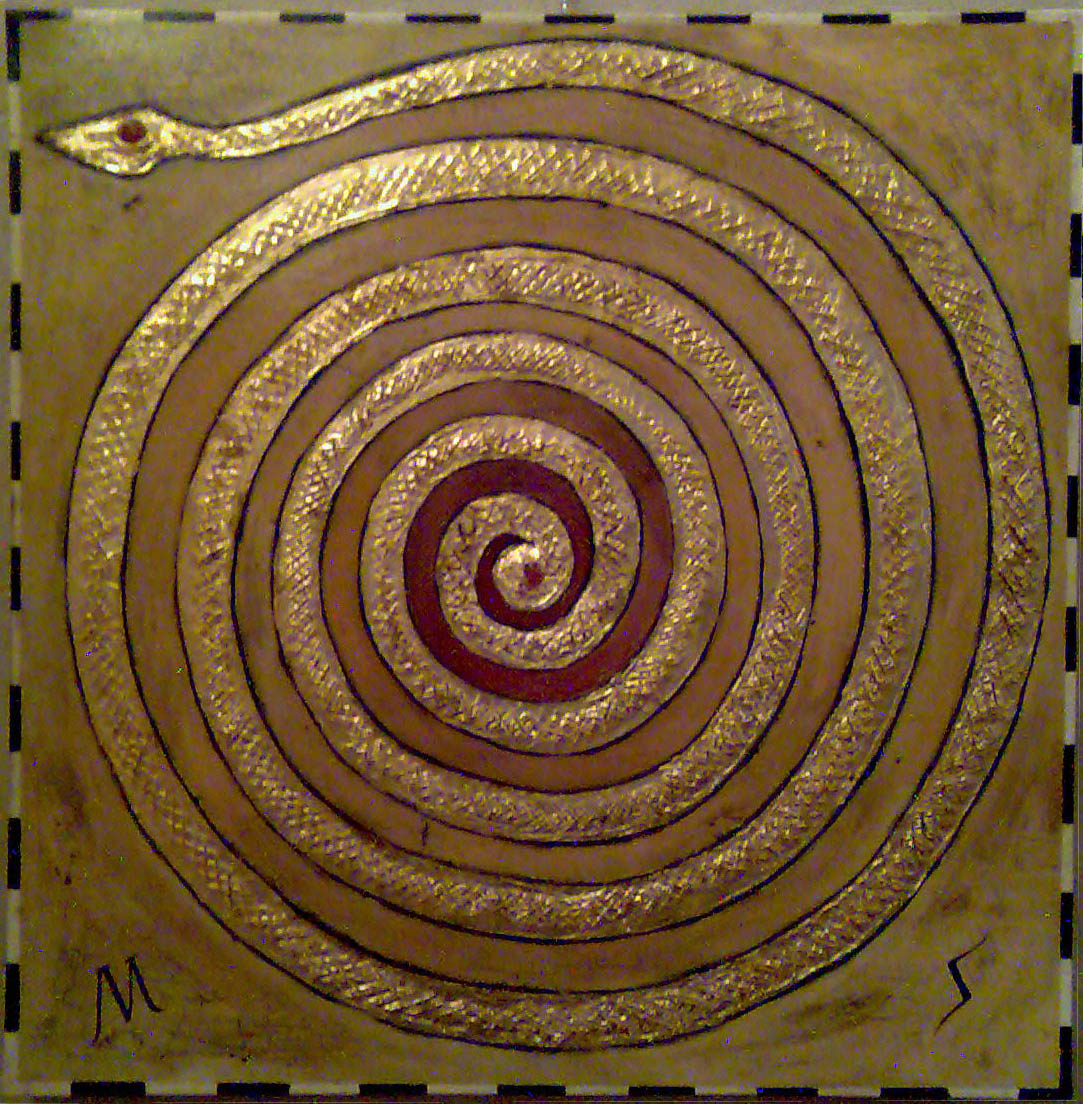
Eurynome then grabbed the Wind of the North (Borea) and took out from it Ophion the Snake. He then impregnated her.
At once, flying above the sea, she took the shape of a dove and, at the right time, laid the Universal Egg. By order of the goddess, Ophion coiled seven times around the egg, until it hatched and all existing things came out of it, children of Eurynome: the Sun, the Moon, the planets, the stars, the Earth with its mountains, its rivers, its trees and the herbs and the living creatures.
When Ophions boasted about being the only creator, Eurynome kicked his teeth off and threw him into the underground caves. Then she created the seven planetary powers and placed on each a Titan and a Titaness."
In the first chapter of "The Greek Myth", Robert Graves expounds his reconstruction of the original myth of creation by the Pelasgians, the pre-hellenic inhabitants of Greece.
This myth was present in different variants with all peoples of
the Mediterranean. 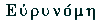 means "she who inhabits vast spaces" o "she who reign upon the spaces",
from
means "she who inhabits vast spaces" o "she who reign upon the spaces",
from  "vast"
e
"vast"
e  "to distribute,
to assign, to take to pasture, to inhabit, to be owner". Therefore,
it is possible to translate the name Eurynome con the
Lady of Space or even the Lady of Chaos. Here she is meant as the
creating manifestation of the Mediterranean Great Goddess. She is also a personification of the Moon.
"to distribute,
to assign, to take to pasture, to inhabit, to be owner". Therefore,
it is possible to translate the name Eurynome con the
Lady of Space or even the Lady of Chaos. Here she is meant as the
creating manifestation of the Mediterranean Great Goddess. She is also a personification of the Moon.
in the Bible we find that before the creation "the spirit of God flew on the waters" (Genesis 1,1); the spirit in Hebrew is feminine and iconographically is representes by a dove. Later on we find Eve who is induced to sin by the snake and then crushes it. The biblical story of the creation, then, owns a lot to ancient Mediterranan myths.
According to Homer all beings are children of Ocean and Tethys (Iliad XIV,201). Ocean is a river surrounding the earth, Tethys is the lady of the waters. It is therefore another version of the couple Ophion-Eurynome. In the Pelasgian version, Ocean and Tethys are a couple of Titans, associated to the planet Venus.
The Pelasgians asserted that they were born from the teeth of Ophion. In
a later version of the myth Cadmus, the founding hero of Thebes
in Beotia, coming from Palestine, by order of Athena
sowed the teeth of a snake and from them the Spartoi, who became his loyal fellows.
By the way Borea, the Wind of the North, is no one else than Buriash, the athmospheric god worshipped in Babylon.
 In mythology we find another Eurynome, who with Thetis (
 the Nereid mother of Achilles, not
 Tethys
the Titaness partner of Ocean) saved Hephaestus thrown into the sea by Hera, disgusted by his look (Iliad XVIII, 395). This Eurynome
is "daughter of Ocean who flows on itself" (Iliade XVIII,399).
Maybe putting Ocean and Tethys as creators made Eurynome,
in reality confused with Tethys herself, their daughter, and
then friend of Thetis and with her savior of Hepaestus.
These transpositions are possible in myths.
Tethys
the Titaness partner of Ocean) saved Hephaestus thrown into the sea by Hera, disgusted by his look (Iliad XVIII, 395). This Eurynome
is "daughter of Ocean who flows on itself" (Iliade XVIII,399).
Maybe putting Ocean and Tethys as creators made Eurynome,
in reality confused with Tethys herself, their daughter, and
then friend of Thetis and with her savior of Hepaestus.
These transpositions are possible in myths.
Eurynome is a manifestation of divinity, which comes to us from an era at the dawn of history. She is the echo of the beliefs of the peoples whose memory has remained on the threshold of the world we know, in the shape of traces that are present in our culture but are now difficult to recognize. I have chosen her name because she represents the remote and mysterious root of our civilization, without bringing with her references that might influence the mind and arouse prejudices or expectations.
But I have also chosen her because the discovery of the link among hellenic and pre-hellenic, cananaean and hebraic myth shows how all the books of the ancient tradition are the result of a formation process involving the most diverse contributions. I do not want to hide the intention of showing how the Bible is a book like any other in the tradition, as the Iliad for instance. It is a compilation of texts collecting the most diverse influences, from the primitive myths of the Mediterranean to the disputes among the priests of ancient Israel. Those who look for the word of God can find it here as elsewhere. This statement might sound provocatory, but it is the sheer truth: the Bible is a book like the others, very important because it is an essential part of world culture, but not supernatural.
I do not want to hide, as well, my intention to refer to a myth where
the Creatore is female. This is also a sort of a provocation.
Why God and not Goddess? In ancient Greek
it was possible to say tò théion, the divine, which is neuter.
In sanskrit the brahman is neuter. In Chinese there are no grammatical genders
and Tao is referred to with "it" in English. But these concepts refer to the impersonal Absolute.
When you personify the Absolute, it becomes a he or a she...
A.C. - 28th September 2002
Updated on 22nd January 2005
Updated again on 26th November 2006 with new pictures
English version 12th April 2026
"Eurynome" is the correct English spelling, but you find the Italian spelling "Eurinome" in the name of the site and the domain. In Italian "y" changes into "i" in the transcription of Greek names, following the pronunciation.
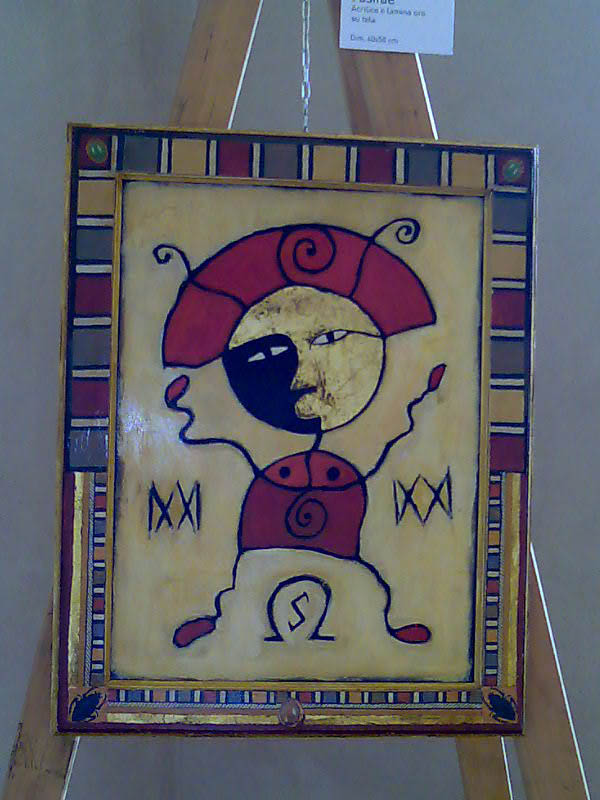
The pictures represent the works of Monica Seksich:
All the contents of the site Eurinome.it are published under a Creative Commons License, except where explicitly indicated.
The images of the works of Monica Seksich are reproduced by concession of the author, who reserves all relevant rights.